
Not sure how these rules apply to you?
Try the GST Decision Assistant to receive a personalised assessment based on your freelance business.
One of the most expensive pieces of freelancer tax advice on the internet is: *"Foreign clients don't attract GST."*
Sometimes that's true. Sometimes it's incomplete. And sometimes it leads freelancers into compliance problems they don't discover until much later.
If you're an Indian freelancer working with overseas clients, you've probably heard terms like Export of Services, LUT, Zero-Rated Supply, IGST, FIRC, and GST Registration. Most articles explain these terms individually. Very few explain how they fit together.
This guide takes a different approach. Instead of explaining what LUT is, we'll explain why freelancers file LUT, how it fits into the export workflow, what can go wrong, and how experienced service exporters actually manage compliance.
A real example
Let's start with a situation that happens every day. A NetSuite consultant in Pune signs a client in Texas. Project value: $12,000. The consultant prepares an invoice. Then a question appears: *should I add 18% GST?*
The answer depends on several things: GST registration status, whether the transaction qualifies as an export of services, whether LUT has been filed, and whether export conditions are actually satisfied. Most freelancers stop after the first question. That's where mistakes begin.
Why LUT exists in the first place
To understand LUT, you first need to understand something that surprises many freelancers: exports are not outside GST. They're handled differently under GST.
Under the GST framework, exports are generally treated as zero-rated supplies. This means the supply still exists, the transaction is still reported, documentation still matters — the treatment is simply different from a domestic supply.
Historically, exporters had two broad options.
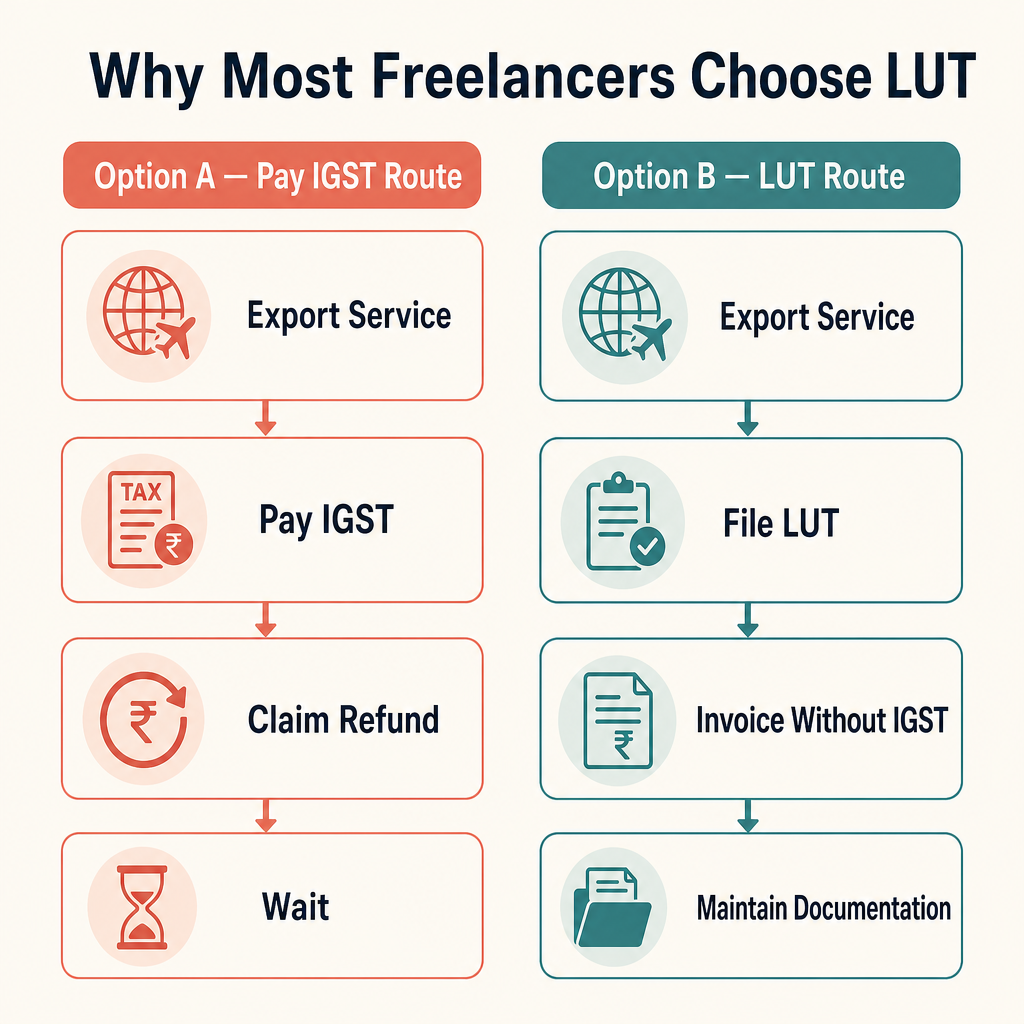
Most freelancers choose the LUT route because it is operationally simpler. That's the practical purpose of LUT.
What exactly is LUT?
LUT stands for Letter of Undertaking. It is a declaration filed through the GST portal that allows eligible exporters to supply goods or services without payment of IGST, subject to applicable conditions.
The document itself is simple. The consequences of understanding it are significant. A valid LUT can prevent unnecessary cash-flow issues and simplify export invoicing.
The most important thing freelancers get wrong
Many freelancers think GST Registration = LUT. They are not the same thing. Think of them as different layers.
- Layer 1 — GST Registration. This gives you a GSTIN.
- Layer 2 — LUT. This allows eligible exports without payment of IGST.
One does not automatically create the other.
Can you file LUT without GST registration?
No. The sequence generally looks like this: GST Registration → LUT Filing → Export Invoices → Foreign Payment → GST Returns. Many freelancers discover LUT before they understand GST registration. That creates confusion.
📘 Filing LUT this year? Chapter 5 of The Survival Guide gives you the full Form RFD-11 walkthrough, the export-invoice declaration language, and the renewal calendar — the things freelancers almost always miss the first time.
Do all foreign clients qualify for LUT benefits?
Not automatically. This is where the concept of Export of Services becomes important.
Many freelancers believe *foreign client = export*. That's not always sufficient. Export treatment depends on satisfying specific GST conditions — among other things, supplier location, recipient location, place of supply, and payment realization. The analysis is more nuanced than most internet discussions suggest.
📖 Survival Guide Reference — Chapter 7: Export of Services Explained. Export qualification framework, freelancer case studies, foreign agency scenarios, and common misconceptions. Get the guide →
The invoice most freelancers should be using
Many freelancers download a generic invoice template from Google. That's risky.
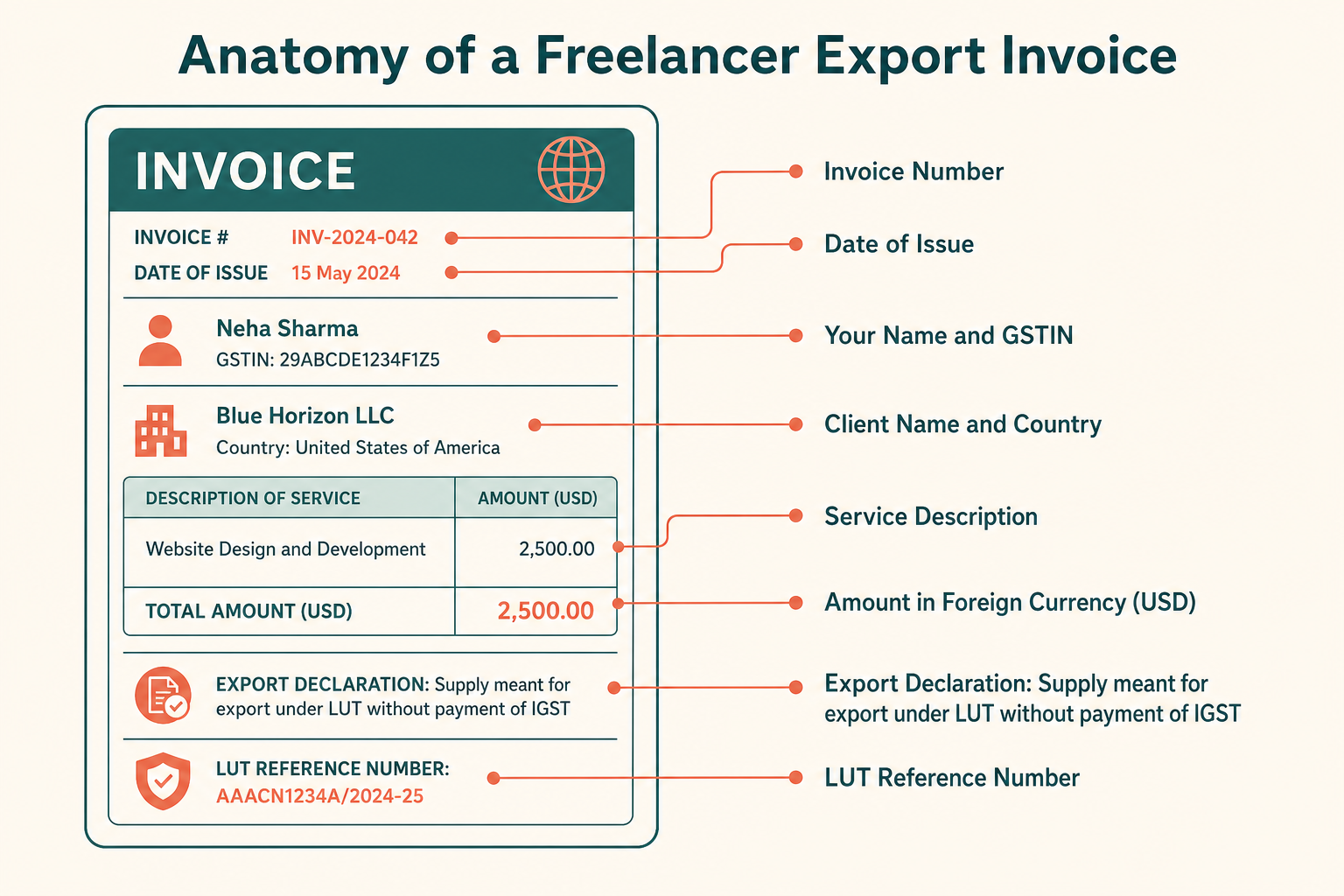
An export invoice should typically contain invoice number, date, client details, service description, invoice value, GSTIN (where applicable), and an LUT-related declaration. One commonly used declaration is:
"Supply meant for export under Letter of Undertaking without payment of Integrated Tax."
Your CA may recommend alternative wording based on the facts of your case. The important point is that the invoice should accurately reflect the nature of the transaction.
The part nobody talks about: payment realization
This is where theory becomes reality. Many freelancers assume invoice issued = compliance complete. Not quite.
Export transactions generally require proper realization of proceeds. In practical terms: the money actually needs to arrive. This is one reason experienced CAs emphasize FIRC, FIRA, bank statements, and payment records. An unpaid export invoice creates a very different compliance situation than a paid one.
📖 Survival Guide Reference — Chapter 8: Foreign Remittances & Documentation. Wise workflows, FIRC vs FIRA, invoice-to-payment mapping, and documentation templates. Get the guide →
What happens if you forget to file LUT?
This is one of the most common freelancer questions. Scenario: you are GST registered, you export services, you invoice without charging IGST — then you discover LUT was never filed.
This is not a situation you want to discover during a year-end review. The appropriate corrective action depends on the facts and should be discussed with your CA. The larger lesson: LUT should be part of your annual compliance checklist, not an afterthought.
What if you have both Indian and foreign clients?
This is extremely common. Example: domestic clients ₹8 lakh, foreign clients ₹18 lakh, total revenue ₹26 lakh. Many freelancers incorrectly assume foreign invoices follow one GST system and domestic invoices follow another. In practice, your compliance obligations need to accommodate both.
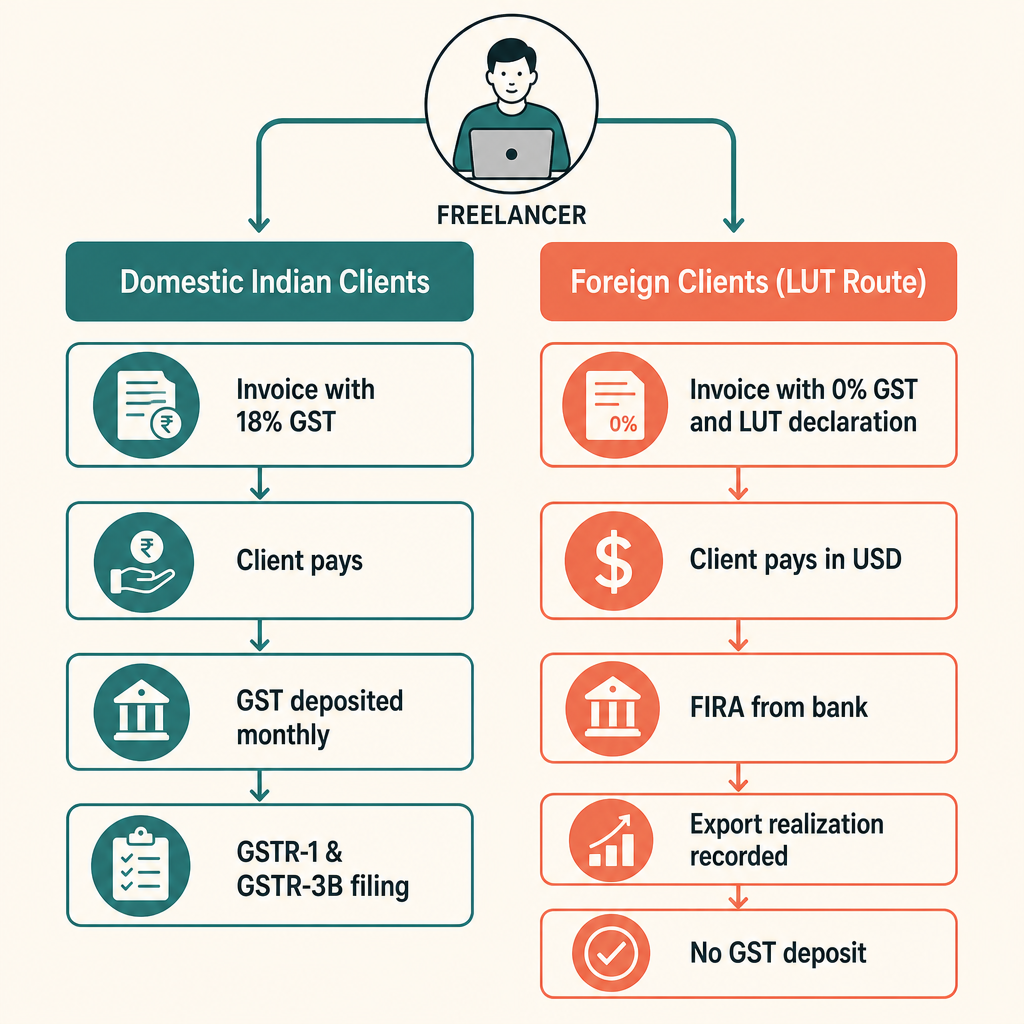
This is where bookkeeping discipline becomes important. Maintain separate tracking for domestic invoices, export invoices, LUT-covered transactions, and foreign remittances.
The documentation stack every freelancer should maintain
For each export transaction:
- ✓ Invoice
- ✓ Client agreement
- ✓ LUT
- ✓ Payment confirmation
- ✓ FIRC or FIRA
- ✓ Bank statement
- ✓ Email trail
If you cannot reconstruct a transaction two years later, your documentation system needs work.
The annual LUT workflow
The most organized freelancers treat LUT as a recurring process: April → Verify GST Registration → File LUT → Issue Export Invoices → Maintain Documentation → Review Records Quarterly → Renew Next Financial Year.
This takes surprisingly little time when done proactively.
📖 Survival Guide Reference — Chapter 12: Annual Freelancer Compliance Review. Quarterly review process, missing-document detection, compliance calendar, and year-end readiness checklist. Get the guide →
✅ Want the one-page map? Grab the free Freelancer Compliance Checklist — GST, LUT, FIRC, invoicing and income tax in one PDF. We'll email it instantly.
Common LUT mistakes
- Mistake #1 — Assuming foreign clients automatically eliminate GST obligations.
- Mistake #2 — Confusing LUT with GST registration.
- Mistake #3 — Using generic invoice templates.
- Mistake #4 — Not maintaining remittance records.
- Mistake #5 — Ignoring annual renewal.
- Mistake #6 — Relying entirely on memory instead of documentation.
Frequently asked questions
Do I need LUT if all my clients are outside India?
If you are GST registered and exporting services, LUT often becomes a key part of the compliance framework.
Does LUT expire?
It is generally filed for a financial year and should be reviewed annually.
Can I charge foreign clients without GST?
Potentially yes, if the applicable export conditions are satisfied and the compliance framework is properly followed.
Does LUT replace FIRC?
No. LUT and FIRC solve different problems.
Do I need a separate LUT for every client?
No. The filing is not typically client-specific.
Final thoughts
The best way to think about LUT is not as a tax benefit. Think of it as a workflow: GST Registration → LUT → Export Invoice → Foreign Payment → Documentation → GST Returns.
Freelancers who understand this workflow rarely struggle with export compliance. Freelancers who focus only on individual forms often do.
The goal is not to become a GST expert. The goal is to build a system that continues working long after the invoice has been paid.
🧭 Need this dialed in for your situation? Start with the Survival Guide for the full system, or book a 1-on-1 consultation on Topmate if you'd rather walk through your own numbers with someone.
Continue learning
Related guides on Decompiled.tax:
- The ₹20 Lakh GST Myth That Confuses Indian Freelancers
- GST Registration for Indian Freelancers
- Export of Services Under GST
- FIRC for Freelancers
- FIRC vs FIRA Explained
- GST on Foreign Clients
For a complete operational playbook covering GST registration, LUT filing, export invoicing, remittance documentation, recordkeeping systems, and tax planning, see 📖 The Indian Freelancer's GST & Income Tax Survival Guide.
Want a one-on-one walkthrough of your own situation? Book a consultation on Topmate →