
Not sure how these rules apply to you?
Try the GST Decision Assistant to receive a personalised assessment based on your freelance business.
A surprisingly large number of freelancers discover FIRC the same way. Not while signing a client. Not while receiving a payment. Not while filing GST. But months — or sometimes years — later when their Chartered Accountant asks: *"Do you have the FIRC for these foreign payments?"*
The usual response is confusion. You received the money. You have the invoice. You have the bank statement. What exactly is a FIRC, and why is everyone suddenly treating it like an important document?

The short answer: FIRC (or its modern equivalent, FIRA) is one of the documents that helps prove that money entered India from a foreign client. If you earn from overseas customers through Wise, Payoneer, PayPal, Stripe, or direct bank transfers, understanding this document is part of building a clean compliance trail.
Let's unpack how it works.
A freelancer's first encounter with FIRC
Consider this situation. An ERP consultant in Pune works with a client in Texas. Every month: invoice issued for $2,500, payment received through Wise, money credited to an Indian bank account. Everything appears straightforward.
Two years later, while reviewing records, the CA asks: Can you prove these were export receipts? Do you have remittance documentation? Do you have invoice-to-payment mapping?
The consultant has invoices. The consultant has bank statements. But there is no documentation showing how the foreign funds entered India. That's when FIRC enters the conversation.

What is a FIRC?
FIRC stands for Foreign Inward Remittance Certificate. Historically, it was issued by Authorized Dealer (AD) banks when foreign currency entered India.
Think of it as a banking record that confirms:
- Money came from outside India
- The funds were received by a specific beneficiary
- The remittance was processed through authorized channels
- The transaction was categorized under a specific purpose code
A typical FIRC contains remitter details, beneficiary details, currency received, INR equivalent, date of remittance, bank reference information, and a purpose code. In practical terms, it helps establish that the money in your account originated as a foreign remittance.
Why does this matter?
Because compliance is rarely about a single document. It's about building a chain of evidence. For a foreign-client payment, that chain usually looks like this:
Client Contract → Invoice → Payment → Remittance Documentation → Bank Credit → Accounting Records → GST / Income Tax Filing
If one link is missing, reconstruction becomes harder later. Most freelancers only discover this after their transaction history has grown into hundreds of entries.
The real reason your CA is asking for it
Your CA usually isn't interested in FIRC for its own sake. They're trying to answer a bigger question: *Can this foreign income be properly supported if questions arise later?*
The document often becomes relevant when discussing export of services, LUT compliance, GST recordkeeping, foreign remittance documentation, and audit preparedness. The CA is essentially asking: "Can we demonstrate where this money came from?"
FIRC vs FIRA: why the internet makes this more confusing than it needs to be
One reason freelancers get confused is because different platforms use different terminology.
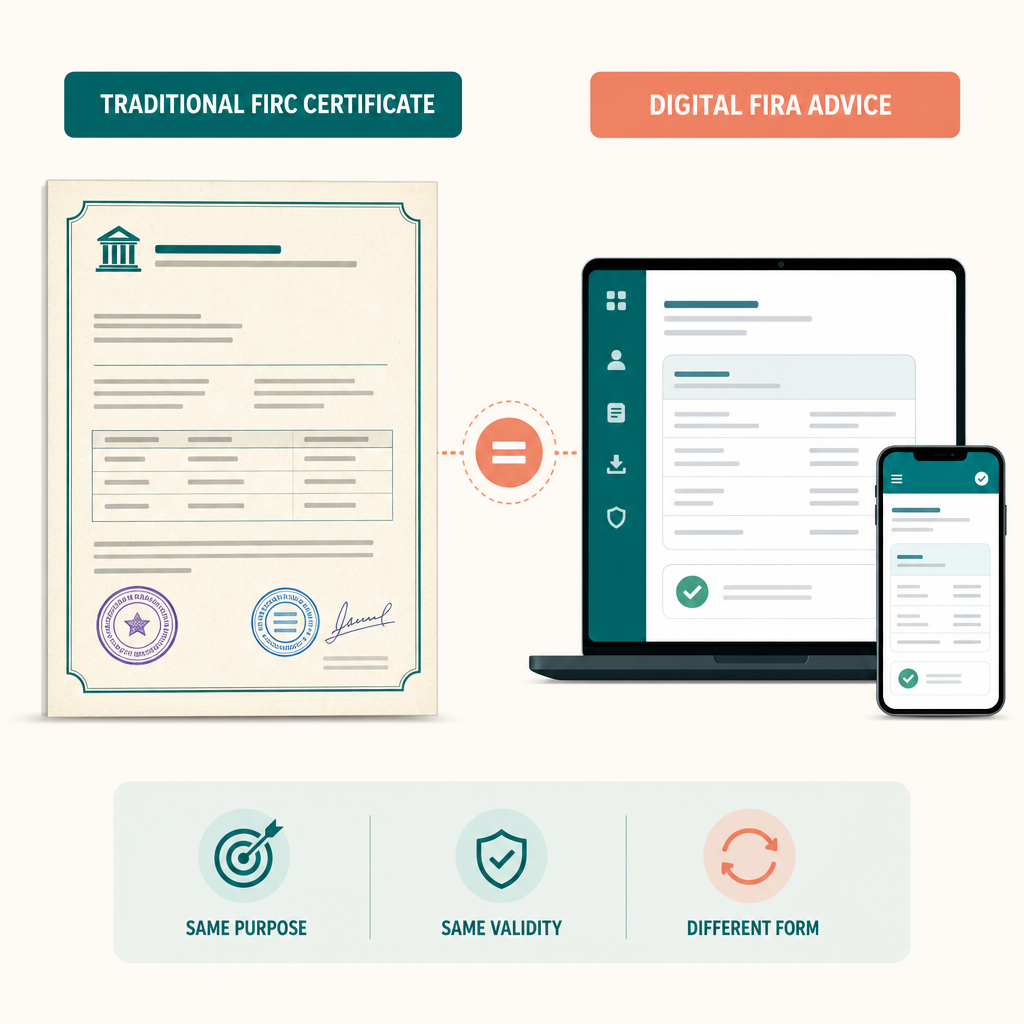
Historically, FIRC was issued by banks. Today, many freelancers receive FIRA (Foreign Inward Remittance Advice) through banking partners and payment providers. The terminology differs. The purpose is largely the same: to document foreign inward remittances.
If your payment platform provides FIRA instead of FIRC, preserve it. The most important thing is maintaining documentation for the remittance itself. For a side-by-side breakdown see FIRC vs FIRA explained.
How FIRC relates to GST
This is where the topic becomes important for freelancers. Many professionals earning from foreign clients rely on GST export provisions. When discussing export of services, one recurring requirement is demonstrating that payment has been received in foreign exchange (or as otherwise permitted under applicable regulations). This is one reason remittance documentation is commonly retained.
A frequent misconception is: *"If I have a LUT, I don't need FIRC."* That's incorrect. The two documents serve different purposes.
- LUT — a declaration that allows eligible exporters to supply services without payment of IGST, subject to applicable conditions.
- FIRC / FIRA — evidence relating to the receipt of foreign funds.
One is a declaration. The other is supporting documentation.
📘 Tired of reconstructing FIRC paperwork after the fact? Chapter 6 of The Survival Guide walks through the exact remittance documentation system — Wise, Payoneer, PayPal, direct wires — so every foreign payment lands in a clean folder the day it arrives.
How FIRC relates to export of services
Many freelancers hear *"exports are zero-rated."* What they don't hear is *"you still need documentation."* Export treatment under GST is built around satisfying specific conditions, and remittance records form part of the broader evidence trail supporting those transactions.
That's why experienced practitioners generally advise freelancers to maintain — for every foreign payment — the invoice, payment confirmation, FIRC/FIRA, bank statement, and client details. Read the deeper walkthrough in Export of Services Under GST.
📖 Survival Guide Reference — Chapter 7: Export of Services Explained. Includes the five export conditions, real freelancer examples, common compliance traps, and decision trees for GST registration. Get the guide →
Does Section 44ADA require FIRC?
No. Section 44ADA is an income-tax provision. FIRC does not determine whether you qualify. However, maintaining remittance records helps support the source of professional income, the nature of receipts, and the consistency of your records. Good documentation is never a disadvantage.
📖 Survival Guide Reference — Chapter 10: Section 44ADA in Practice. Eligibility analysis, examples for consultants and software developers, tax regime comparisons, and advance tax implications. Get the guide →
How to get FIRC or FIRA
The answer depends on how you receive payments.
Direct international wire transfer
If your client sends money directly to your Indian bank account: contact your bank's forex department, request inward remittance documentation, download and archive the records, and match them with the corresponding invoice. Different banks use different processes — some provide online access, others require a request.
Wise
If you receive payments through Wise: save transfer confirmations, download any remittance-related documentation, maintain transaction history exports, and archive everything alongside invoices. Don't assume you'll remember which payment relates to which invoice a year later.
Payoneer
Maintain transaction reports, payment confirmations, bank credit records, and any remittance documentation provided.
PayPal
Download and archive transaction reports, settlement records, remittance-related documentation, and bank credits. Treat each payment as a complete file.
The documentation system every freelancer should have
Create a folder for every invoice.

A typical folder for 2026 might look like:
- INV-101.pdf
- Client Agreement.pdf
- Payment Confirmation.pdf
- FIRC-FIRA.pdf
- Bank Statement.pdf
This takes less than two minutes per payment. It can save hours of reconstruction later.
Common mistakes freelancers make
Waiting until tax season. By then, documentation may be difficult to retrieve.
Keeping only bank statements. Bank statements show money arrived. They don't always provide the same remittance context.
Not matching payments to invoices. This becomes painful once you cross 50–100 transactions.
Assuming small payments don't matter. The ₹10,000 payment deserves the same documentation discipline as the ₹2 lakh payment.
✅ Want a quick win first? Grab the free 5-minute GST decision checklist — we'll email the PDF and you'll know in five minutes whether GST registration applies to your situation.
A simple rule to remember
For every foreign payment, keep:
- ✓ Invoice
- ✓ Client details
- ✓ Payment confirmation
- ✓ FIRC or FIRA
- ✓ Bank statement
If you consistently do this, you'll solve most of the documentation problems that cause freelancers stress later.
Final thoughts
FIRC is one of those documents that seems unnecessary until the day someone asks for it. Then it suddenly becomes important. The freelancers who stay compliant aren't necessarily tax experts — they're simply organized.
When a foreign payment arrives, don't just celebrate the invoice being paid. Take two extra minutes to save the paperwork that proves where the money came from. Your future self — and probably your CA — will appreciate it.
🧭 Need this dialed in for your situation? Start with the Survival Guide for the full system, or book a 1-on-1 consultation on Topmate if you'd rather walk through your own numbers with someone.
Continue learning
Related guides on Decompiled.tax:
- The ₹20 Lakh GST Myth That Confuses Indian Freelancers
- GST Registration for Indian Freelancers
- FIRC vs FIRA: What's the Difference?
- LUT Filing Guide for Freelancers
- Export of Services Under GST
- Section 44ADA for Software Developers
For the complete system covering GST, LUT, FIRC/FIRA, 44ADA, invoicing, recordkeeping, and tax planning, see 📖 The Indian Freelancer's GST & Income Tax Survival Guide.
Continue reading
FIRC sits inside a larger workflow. If you're setting up your first foreign engagement, the next steps in the sequence are:
- Getting Paid by Foreign Clients — the complete hub
- FIRC vs FIRA Explained
- Export of Services Under GST
- Wise for Indian Freelancers — *coming soon*
- Skydo for Indian Freelancers — *coming soon*
- Receiving International Payments — *coming soon*
Want a one-on-one walkthrough of your own situation? Book a consultation on Topmate →