
A surprisingly common freelancer conversation goes something like this:
*"My CA asked me for a FIRC."* … *"Wise only gave me a FIRA."* … *"Are they the same thing?"*
And that's where the confusion starts. If you earn from foreign clients through Wise, Payoneer, PayPal, Stripe, or direct international bank transfers, you've probably encountered both terms. The problem is that most explanations online are written for bankers, not freelancers.
This guide explains what FIRC is, what FIRA is, why the distinction exists, why your CA keeps asking about them, how they relate to GST exports, and what documentation freelancers should actually maintain. Most importantly: why treating them as "just paperwork" can create compliance problems later.
The short answer
Historically, FIRC (Foreign Inward Remittance Certificate) was issued by Authorized Dealer (AD) banks. Today, many freelancers receive FIRA (Foreign Inward Remittance Advice) through payment providers and their banking partners.
They are not technically identical documents. However, both serve a similar practical purpose: helping demonstrate that foreign funds entered India through authorized channels.
The real issue is not *which acronym* you received. The real issue is whether you can properly document your foreign receipts.
FIRC vs FIRA at a glance
| Aspect | FIRC | FIRA |
|---|---|---|
| Full form | Foreign Inward Remittance Certificate | Foreign Inward Remittance Advice |
| Issuer | Authorized Dealer (AD) bank | Bank or payment partner |
| Format | Formal certificate | System-generated advice |
| Typical channel | Direct bank wire (SWIFT) | Wise, Payoneer, PayPal, Stripe |
| Purpose | Evidence of foreign inward remittance | Evidence of foreign inward remittance |
| Practical use | Often expected by CAs and GST authorities | Commonly accepted as remittance proof |
| Availability | On request, sometimes a small fee | Often available automatically |
Why this topic matters more than most freelancers realize
Most freelancers don't think about FIRC or FIRA when money arrives. They think about landing the client, sending the invoice, and getting paid. The documentation conversation usually happens much later — at GST registration, LUT filing, an export documentation review, tax filing, a compliance audit, or a CA review.
That's why so many freelancers discover these documents months or years after receiving payments.
📘 Want to stop mixing up FIRC, FIRA, and bank advices? The Survival Guide includes the side-by-side document matrix and a per-platform retrieval playbook (HDFC, ICICI, Axis, Wise, Payoneer) you can hand to your CA.
Where FIRC and FIRA fit into the freelancer workflow
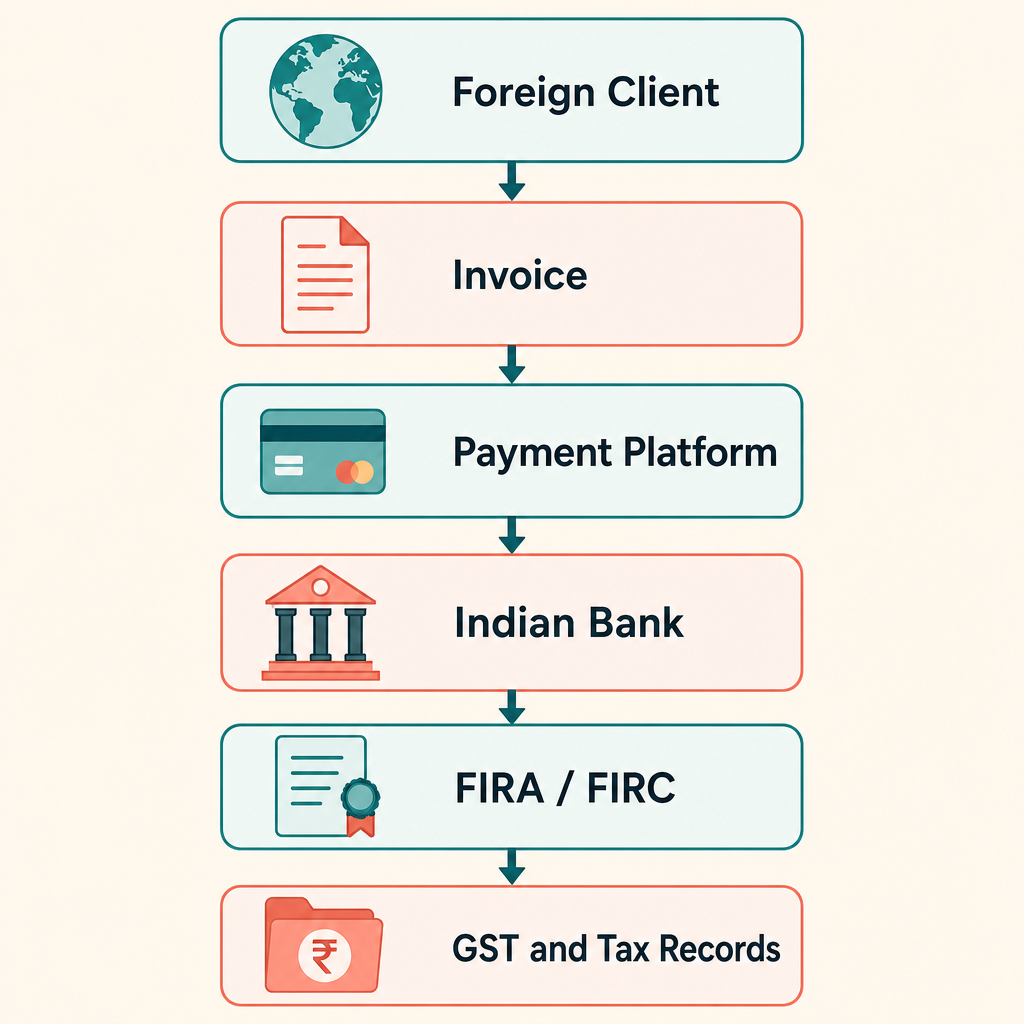
Money moved. But compliance systems care about something else: *can the movement of funds be documented?* That's where remittance documentation enters the picture.
What is FIRC?
FIRC stands for Foreign Inward Remittance Certificate. Historically, it was issued by Authorized Dealer banks. A traditional FIRC typically contains sender details, recipient details, amount received, currency received, INR conversion value, date of remittance, purpose code, and bank references.
Think of it as a formal banking record documenting a foreign inward remittance. For years, this was the document many CAs expected to see.
What is FIRA?
FIRA stands for Foreign Inward Remittance Advice. As fintech platforms became more common, remittance documentation evolved. Today, many freelancers receiving payments through Wise, Payoneer, PayPal, or other payment intermediaries receive FIRA documentation rather than traditional bank-issued FIRC certificates.
This is often where confusion begins. The freelancer receives FIRA. The CA asks for FIRC. The freelancer assumes something is missing. Not necessarily.
Why did the industry shift toward FIRA?
Because payment flows changed.
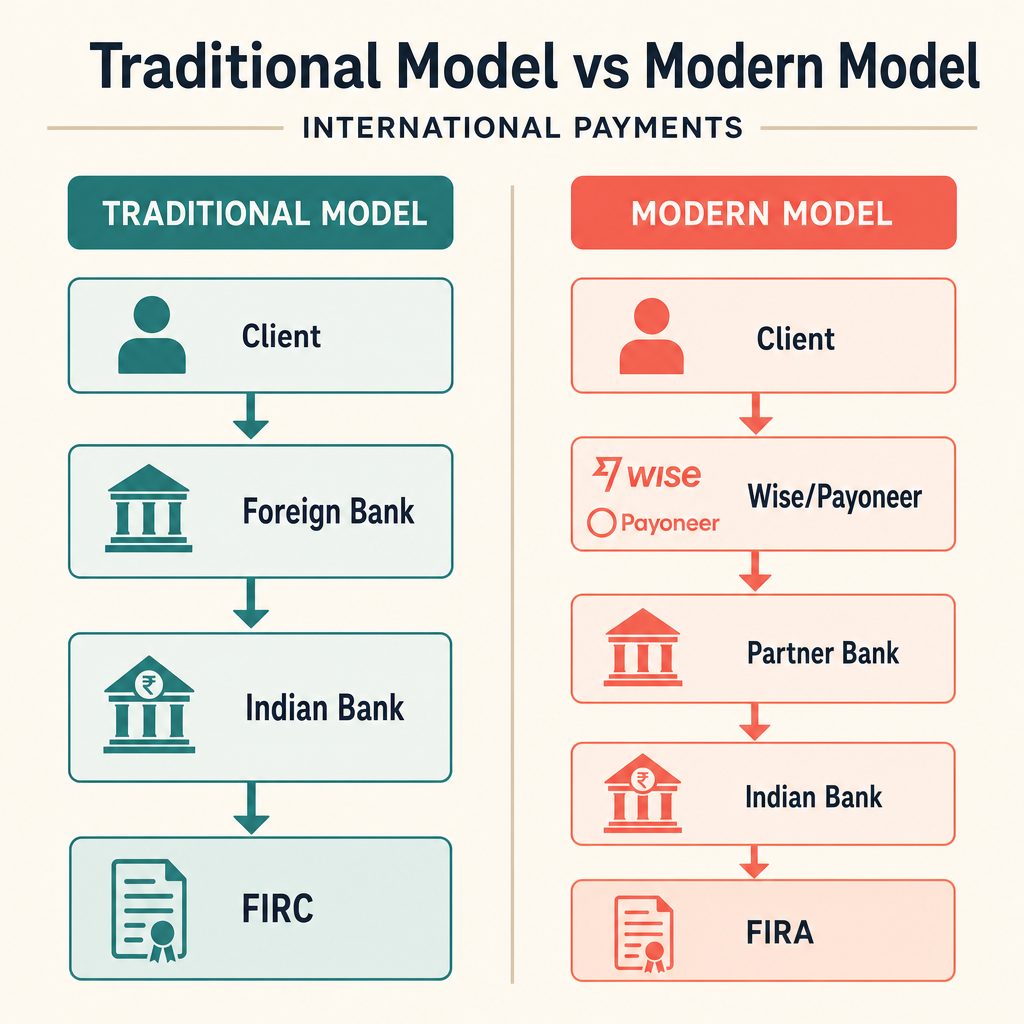
The documentation process evolved alongside the payment infrastructure. The traditional model routed money through correspondent banks. The modern model routes it through fintech platforms and their partner banks — and the document you receive reflects that.
Can FIRA replace FIRC?
This is the question freelancers actually care about.
The practical answer: in many freelancer situations, FIRA serves the same evidentiary purpose as traditional FIRC documentation. However, different authorities, different compliance requirements, different contexts, and different expectations all matter. This is why your CA may ask for documentation rather than specifically insisting on a particular acronym.
The important question is: *can the foreign receipt be properly documented?*
Where GST enters the picture
Most freelancers hear about FIRC or FIRA because of GST — specifically, export of services. When claiming export treatment under GST, documentation becomes important. Your records typically include the invoice, client information, payment evidence, bank records, and remittance documentation. FIRC or FIRA often forms part of this documentation chain.
The issue isn't that GST law says *"you must have this exact acronym."* The issue is: *you should be able to demonstrate what happened.*
📖 Survival Guide Reference — Chapter 7: Export of Services Explained. The five export conditions, foreign-client scenarios, GST decision trees, and documentation requirements. Get the guide →
Why your CA keeps asking for it
Most CAs aren't trying to make your life difficult. They're trying to answer questions like: did foreign currency actually enter India? Can we support export treatment? Is the documentation complete? Can receipts be traced to invoices?
The CA is thinking about future scrutiny. The freelancer is thinking about today's invoice. That's why the conversation feels disconnected.
The real risk isn't missing FIRC
The real risk is incomplete documentation.

Consider Freelancer A — maintains invoice, contract, Wise receipt, FIRA, bank statement. Result: a clear audit trail. Now consider Freelancer B — keeps only the bank statement. Result: future reconstruction becomes difficult.
The difference is not the acronym. The difference is documentation quality.
What documents should freelancers actually keep?
For every foreign payment, maintain:
- Invoice
- Client information
- Contract or SOW
- Payment confirmation
- FIRC or FIRA
- Bank statement
Think in terms of systems, not documents. The goal is creating a complete transaction history.
📖 Survival Guide Reference — Chapter 8: Foreign Remittances & Documentation. Invoice-to-payment mapping, Wise workflows, FIRA retrieval procedures, audit preparation checklists, and recordkeeping templates. Get the guide →
✅ Want a quick win first? Grab the free 5-minute GST decision checklist — we'll email the PDF and you'll know in five minutes whether GST registration applies to your situation.
Common mistakes freelancers make
- Mistake #1 — Thinking FIRC and FIRA are interchangeable in every context.
- Mistake #2 — Waiting until tax season to retrieve records.
- Mistake #3 — Keeping only bank statements.
- Mistake #4 — Not linking invoices to payments.
- Mistake #5 — Assuming payment platforms store records forever. Always maintain your own archive.
Frequently asked questions
Which is better: FIRC or FIRA?
Neither is "better." They arise from different payment and banking workflows.
Does Wise issue FIRC?
Wise commonly provides remittance-related documentation through its banking arrangements, often resulting in FIRA documentation rather than traditional FIRC.
Will my CA accept FIRA?
In many freelancer situations, FIRA is commonly used as supporting remittance documentation. Specific requirements depend on context.
Do I need both FIRC and FIRA?
Not usually. What matters is maintaining complete and reliable remittance records.
Final thoughts
Most freelancers obsess over the difference between FIRC and FIRA. In reality, that's often the wrong question.
The better question is: *can I prove how this foreign payment moved from my client to my bank account?* If the answer is yes — and your records are complete — you're already ahead of most freelancers.
FIRC and FIRA are simply different pieces of a larger documentation system. The freelancers who avoid compliance headaches aren't the ones who memorize acronyms. They're the ones who build good recordkeeping habits before they need them.
🧭 Need this dialed in for your situation? Start with the Survival Guide for the full system, or book a 1-on-1 consultation on Topmate if you'd rather walk through your own numbers with someone.
Continue learning
Related guides on Decompiled.tax:
- The ₹20 Lakh GST Myth That Confuses Indian Freelancers
- FIRC for Freelancers in India
- GST Registration for Freelancers
- Export of Services Under GST
- LUT Filing Guide
- GST on Foreign Clients
For a complete framework covering GST exports, foreign remittances, LUT filing, FIRC/FIRA documentation, and freelancer recordkeeping, see 📖 The Indian Freelancer's GST & Income Tax Survival Guide.
Want a one-on-one walkthrough of your own situation? Book a consultation on Topmate →