
One of the strangest moments in freelancing happens after a good year.
You earn more.
You land better clients.
You invoice more than ever before.
Then your CA tells you:
"You should have paid advance tax."
Your reaction is usually:
"But I'm filing my return. Why do I need to pay tax before filing my return?"
That's the question almost every freelancer asks the first time they encounter advance tax.
And unfortunately, many people discover it only after interest has already been charged.
The good news?
Advance tax is far less complicated than most freelancers think.
You don't need perfect forecasts.
You don't need a finance degree.
You just need a system.
Let's build one.
The real problem advance tax solves
Imagine two freelancers.
Freelancer A
Revenue: ₹25 lakh
Pays taxes only at year-end.
Freelancer B
Revenue: ₹25 lakh
Pays tax throughout the year.
From the government's perspective:
Freelancer B is preferred.
That's the fundamental reason advance tax exists.
Instead of waiting until the end of the financial year, the tax system expects many taxpayers to pay portions of their expected tax liability during the year itself.
The question most freelancers ask
"Do I even need to worry about advance tax?"
The answer depends on your expected tax liability.
Many freelancers do.
Many freelancers don't realize they do.
That's where problems begin.
Why freelancers are more likely to encounter advance tax
Employees have tax deducted through payroll.
Freelancers often don't.
A freelancer may receive:
- USD payments via Wise
- INR payments from Indian clients
- Consulting retainers
- Project fees
without significant tax being deducted.
As income grows, advance tax becomes increasingly relevant.

The mistake that creates most penalties
Many freelancers believe:
"I'll calculate everything in March."
That feels logical.
But advance tax is designed around the idea of paying during the year.
Waiting until the end may create interest implications.
The exact consequences depend on the facts and applicable provisions.
The important lesson:
Tax planning is easier than penalty management.
The simple advance tax system I recommend
Forget complicated projections.
Here's the system many freelancers can use.
Every quarter:
- Calculate year-to-date revenue.
- Estimate taxable income.
- Estimate annual tax.
- Compare with taxes already paid.
- Pay any shortfall.
That's it.
The goal is not perfect forecasting.
The goal is staying reasonably aligned with reality.
A real example
Let's assume:
Software Developer
Revenue by September: ₹18 lakh
Expected Full-Year Revenue: ₹36 lakh
Using a presumptive framework such as Section 44ADA (where applicable):
Estimated Taxable Income: ₹18 lakh
Now the freelancer can estimate:
- Tax liability
- Amount already paid
- Additional amount required
The calculation becomes dramatically easier when performed quarterly instead of once per year.
📘 Hate the quarterly advance-tax scramble? The Survival Guide includes an advance-tax planner, the four installment deadlines, the interest-penalty math, and templates so you stop overpaying — or underpaying — every quarter.
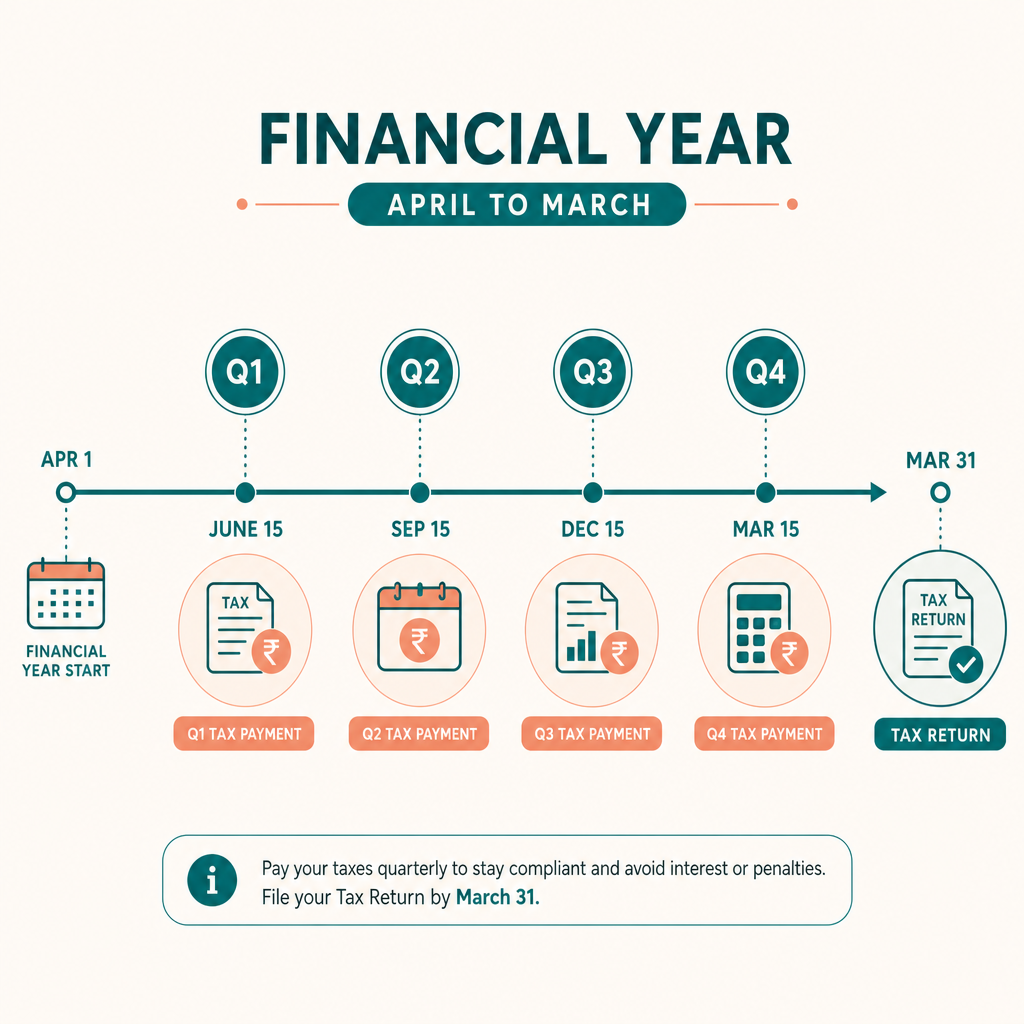
The quarterly dates most freelancers forget
The biggest operational challenge isn't calculation.
It's remembering.
Many freelancers are busy:
- Delivering projects
- Attending client calls
- Managing invoices
Tax deadlines often become an afterthought.
That's why a recurring calendar reminder is worth more than a complex spreadsheet.
The advance tax dashboard every freelancer should maintain
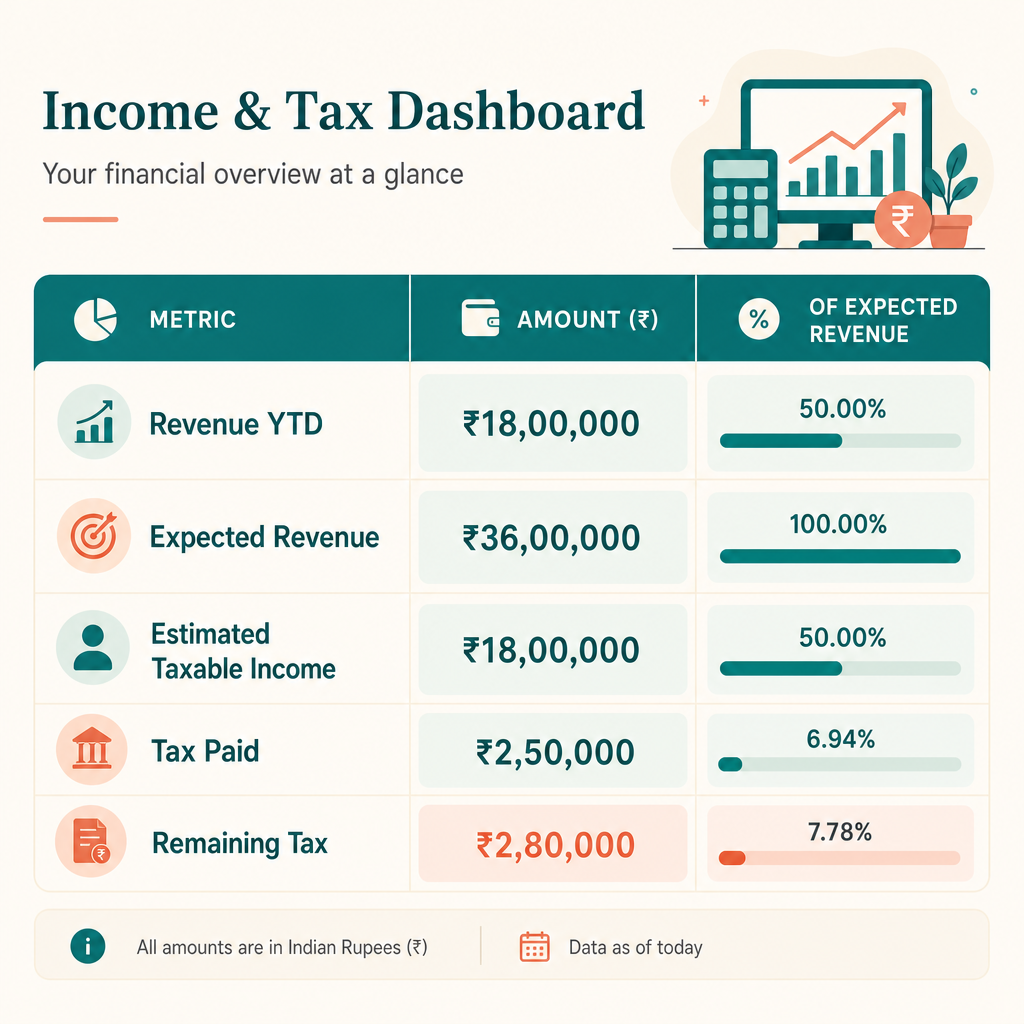
A surprisingly simple spreadsheet can solve most problems.
| Metric | Value |
|---|---|
| Revenue YTD | ₹18,00,000 |
| Expected Revenue | ₹36,00,000 |
| Estimated Taxable Income | ₹18,00,000 |
| Tax Paid | ₹2,50,000 |
| Remaining Tax | ₹2,80,000 |
Most freelancers already track revenue.
The missing piece is converting revenue into a tax estimate.
What about Section 44ADA?
This is where advance tax becomes much easier.
Many freelancers struggle because:
Revenue ≠ Taxable Income
Under 44ADA, eligible professionals may use a presumptive approach.
This can significantly simplify annual tax estimation.
Instead of tracking every business expense for planning purposes, a freelancer can estimate taxable income more quickly.
Practical example
ERP Consultant
Annual Revenue: ₹48 lakh
Assumed 44ADA Income: ₹24 lakh
Now the advance tax estimate can be built around the presumptive income figure.
This is one reason many consultants appreciate the operational simplicity of 44ADA.
📖 Survival Guide Reference — Chapter 10: Section 44ADA in Practice. Includes eligibility analysis, ERP consultant examples, revenue forecasting methods, and tax planning workflows. Get the guide →
Edge case #1: Revenue is unpredictable
Many freelancers don't know their year-end income.
That's normal.
Advance tax does not require psychic powers.
It requires reasonable estimation.
Update projections every quarter.
Adjust as new information arrives.
Edge case #2: Large project arrives late in the year
This happens constantly.
Revenue:
- April–December: ₹12 lakh
- January: New contract worth ₹20 lakh
Suddenly the original forecast becomes irrelevant.
This is why quarterly reviews matter.
Your system must adapt.

Edge case #3: Foreign clients pay irregularly
A client delays payment.
Another pays early.
Revenue timing shifts.
Freelancers should base estimates on actual receipts and realistic expectations rather than wishful thinking.
Edge case #4: Using both domestic and foreign clients
Advance tax doesn't care whether your client is in:
- Pune
- London
- New York
Income is income.
The planning framework remains broadly similar.
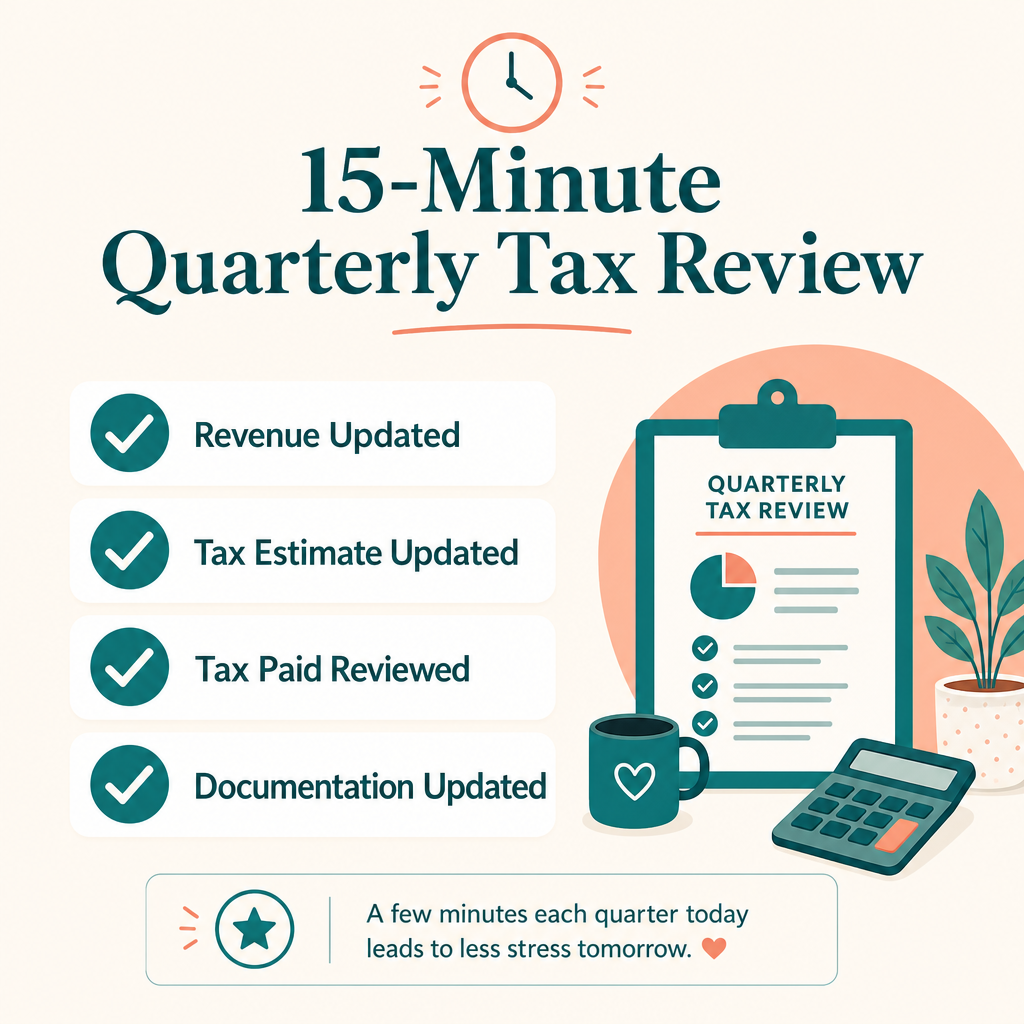
The freelancer tax review template
At the end of every quarter, ask:
- Revenue — What have I earned so far?
- Forecast — What do I expect to earn this year?
- Taxable Income — What is my estimated taxable income?
- Tax Paid — How much tax have I already paid?
- Gap — What remains?
Most advance tax problems become visible immediately when these questions are answered honestly.
Why documentation still matters
Good tax planning begins with good records.
Maintain:
- ✓ Invoices
- ✓ Bank statements
- ✓ Wise records
- ✓ FIRC/FIRA
- ✓ Contracts
- ✓ Expense records
Poor documentation makes tax estimation harder.
Good documentation makes it routine.
📖 Survival Guide Reference — Chapter 8: Foreign Remittances & Documentation. Includes invoice-to-payment mapping, recordkeeping systems, documentation checklists, and audit preparation workflows. Get the guide →
✅ Want a quick win first? Grab the free 5-minute GST decision checklist — we'll email the PDF and you'll know in five minutes whether GST registration applies to your situation.
Common advance tax mistakes
Mistake #1 — Waiting until March.
Mistake #2 — Never updating revenue forecasts.
Mistake #3 — Assuming next quarter will "fix itself."
Mistake #4 — Ignoring large project wins.
Mistake #5 — Treating advance tax as a year-end task.
Frequently asked questions
Do freelancers need to pay advance tax?
Many do, depending on their expected tax liability and circumstances.
Does Section 44ADA eliminate advance tax?
No. They are different concepts.
What if my income changes during the year?
Update your estimates and adjust future payments accordingly.
Does foreign income change advance tax requirements?
Not fundamentally. Tax planning still matters.
Do I need complicated software?
No. A simple quarterly review process is often sufficient.
Final thoughts
The biggest advance tax mistake isn't calculating something incorrectly.
It's not calculating anything at all.
Most freelancers don't need perfect forecasts.
They need visibility.
The easiest way to avoid surprises is:
Revenue Tracking → Quarterly Review → Tax Estimate → Advance Tax Payment → Repeat
Once this becomes part of your business rhythm, advance tax stops feeling like a compliance burden.
It becomes another operational process — just like invoicing, client communication, and project delivery.
And that's exactly how the most organized freelancers treat it.
🧭 Need this dialed in for your situation? Start with the Survival Guide for the full system, or book a 1-on-1 consultation on Topmate if you'd rather walk through your own numbers with someone.
Continue learning
Related guides on Decompiled.tax:
- The ₹20 Lakh GST Myth That Confuses Indian Freelancers
- Section 44ADA for Software Developers
- GST Registration for Indian Freelancers
- LUT Filing for Freelancers
- FIRC for Freelancers
- Export of Services Under GST
For a complete framework covering freelancer tax planning, 44ADA, GST, export documentation, recordkeeping systems, and annual reviews, see 📖 The Indian Freelancer's GST & Income Tax Survival Guide.
Want a one-on-one walkthrough of your own situation? Book a consultation on Topmate →